
UK car history check only £9.99 – check any vehicle instantly
The UK's new car market continued to grow in October, with 152,730 cars registered during the month. That's a 5.4% increase on October last year, according to the latest figures from the Society of Motor Manufacturers and Traders (SMMT).
The short answer
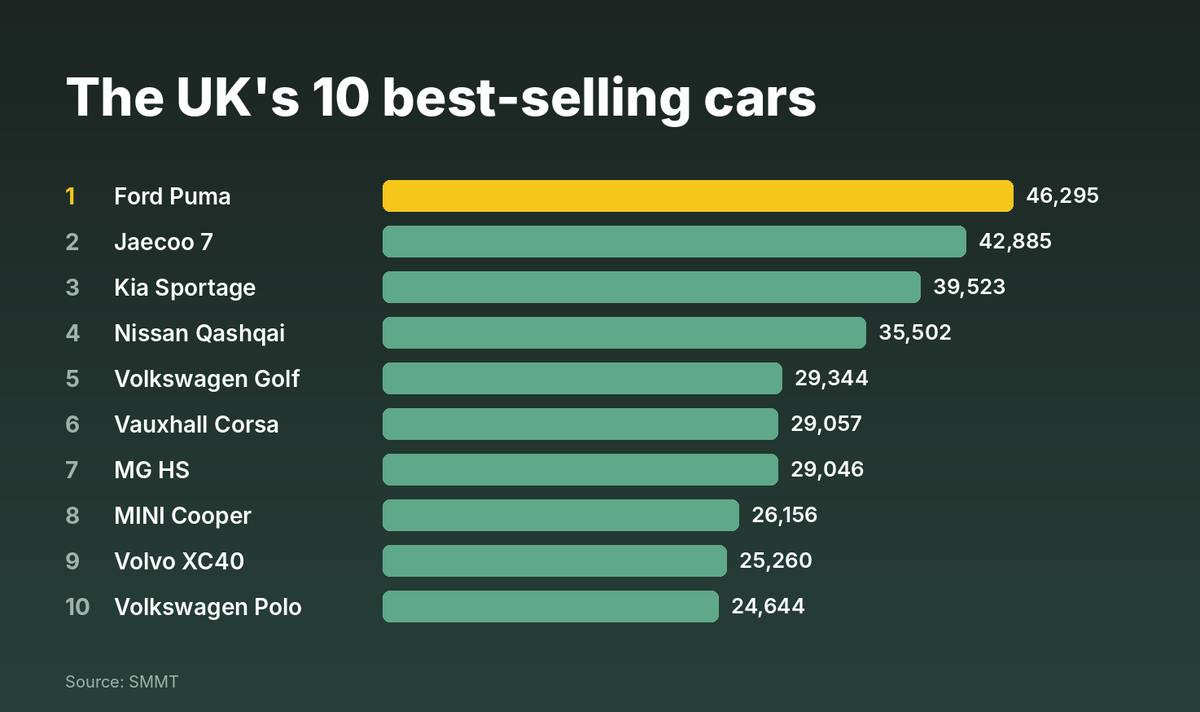
Based on SMMT figures for January to October 2026, the UK's three best-selling cars are:
October marks the 11th consecutive month of growth, taking registrations for the first ten months of 2026 to around 1.89 million. That's 9.8% more than the same period in 2025.
October is traditionally a quieter month for new car sales. Much of the demand surrounding the September number plate change has passed, so manufacturers and dealers often have to work harder to attract buyers. Against that backdrop, another monthly increase is a positive result.
The sales figures are also worth watching if you're in the market for a used car. Today's best-sellers will gradually make their way onto dealer forecourts and used car websites over the next few years.
More popular models usually mean more choice, but it's still important to check the history of any car you're considering. A quick car check before you buy will tell you if it's ever been written off, reported stolen or has outstanding finance.
Source: SMMT
The Ford Puma remains in first place, continuing a run that has seen it finish as the UK's best-selling car in 2023, 2024 and 2025. It has registered 46,295 sales so far this year, giving it a lead of 3,410 over the Jaecoo 7.
However, that gap is looking less secure than it might have done a few months ago. The Jaecoo 7 has been gaining ground and topped the monthly sales chart in March, September and October. With two months still to go, there's a chance the Puma could finally lose its crown.
There have also been a few changes further down the table. The Volkswagen Golf has moved ahead of the Vauxhall Corsa into fifth, while the MG HS is just 11 registrations behind the Corsa. The Volkswagen Polo has also entered the top ten, replacing the Tesla Model 3, which dropped out after a quieter October.
Source: SMMT
The Jaecoo 7 finished October at the top of the table, but its lead over the Ford Puma was hardly huge. Just 43 registrations separated the two, making it another close finish between the pair. It's also the second month in a row that the Jaecoo has taken first place.
MINI had a particularly strong month, with both the Countryman and Cooper making the top ten. The Jaecoo 5 also put in an appearance, giving the relatively new brand two places in the monthly chart.
That's quite an achievement for a manufacturer that has only been selling cars in the UK for around 18 months. It also reflects the growing presence of Chinese carmakers in the UK market.
In October, 15 Chinese brands accounted for 21.6% of all new car registrations. That's more than double their 10.4% share in October 2025. For the year so far, their combined share is just under 18%.
Source: SMMT
There are a couple of notable omissions from October's electric car chart. Neither the Tesla Model 3 nor the Model Y made the top ten, despite finishing first and second respectively in September.
Tesla's sales have traditionally been concentrated towards the end of each quarter, so this isn't necessarily a sign of a longer-term decline. Both models could return to the top end of the chart in December.
In their absence, the Skoda Enyaq took first place, although the competition was close. Just 540 registrations separated it from the Leapmotor B10 in tenth. The list also shows how varied the electric car market has become, with everything from family SUVs and compact crossovers to more conventional passenger cars represented.
Electric car registrations continued to rise in October. A total of 48,858 battery electric vehicles were registered, up 32.7% compared with the same month last year. That gave fully electric cars a 32% share of the market.
Plug-in hybrids also performed well, with registrations increasing by 30.1% to 22,898, representing 15% of the market. Conventional hybrids went in the opposite direction, falling by 5%. Petrol registrations were down 11.6%, while diesel fell by 15.9%.
Taken together, 59% of all new cars registered in October had some form of electrification.
Despite the growth, there's still some way to go before the industry meets its targets. SMMT chief executive Mike Hawes described the progress towards electric motoring as encouraging, but highlighted the considerable cost involved, particularly the discounts and finance offers manufacturers are using to persuade buyers to make the switch. Buyers can also get up to £3,750 off eligible models through the government's Electric Car Grant.
The SMMT expects electric cars to account for around 27% of the market by the end of 2026. That's below the 33% target set under the ZEV mandate, which rises to 38% in 2027.
The Puma has clearly struck a chord with UK buyers. It's compact enough to be easy to drive around town, but there's enough room inside to make it a practical choice for a small family. Its clever under-floor boot storage is another useful touch. Mild-hybrid petrol engines make up the range, alongside the fully electric Puma Gen-E.
The Jaecoo 7's rise up the sales charts has been hard to miss. Competitive pricing and a generous amount of standard equipment have helped it attract plenty of attention. The plug-in hybrid version is particularly interesting, offering a substantial electric-only range and making it an option worth considering for company car drivers.
The Sportage remains a popular choice for families looking for a practical SUV. It has a spacious interior, a good amount of equipment and Kia's seven-year warranty. Buyers can choose between petrol, full hybrid and plug-in hybrid versions, giving the range plenty of appeal.
The Qashqai helped establish the family crossover as one of Britain's favourite types of car, and it continues to sell well. Its e-Power version is an interesting alternative to a conventional hybrid. The wheels are driven by an electric motor, while the petrol engine generates electricity to keep the battery charged. The result is an electric-car-style driving experience without needing to plug in.
The Golf has been around for more than 50 years, but it remains one of the UK's most recognisable family hatchbacks. Its comfortable ride, solid interior and familiar design continue to appeal to private and fleet buyers. It also tends to hold its value well, which helps explain its continued popularity.
There are still two months of registration figures to come before the end of 2026, and the biggest question is whether the Jaecoo 7 can catch the Ford Puma.
The Puma has held the top spot for three years, but the Jaecoo is now close enough to make things interesting. Fleet and business registrations will be worth keeping an eye on, too. They accounted for 62% of October's new car registrations, so large orders placed towards the end of the year could have a significant effect on the final rankings.
The wider picture is one of a changing market. Chinese manufacturers are gaining ground, electric car registrations are increasing and buyers have more choice than ever, particularly when it comes to hybrid and electric SUVs.
For anyone considering a nearly new or used car, that growing choice should be welcome news. Just remember to check the vehicle's history before handing over your money. A quick check could save you from buying a car with outstanding finance, a previous write-off or other problems that aren't immediately obvious.